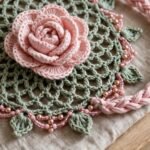
Peach Apricot Rose Bow Dress Crochet Pattern
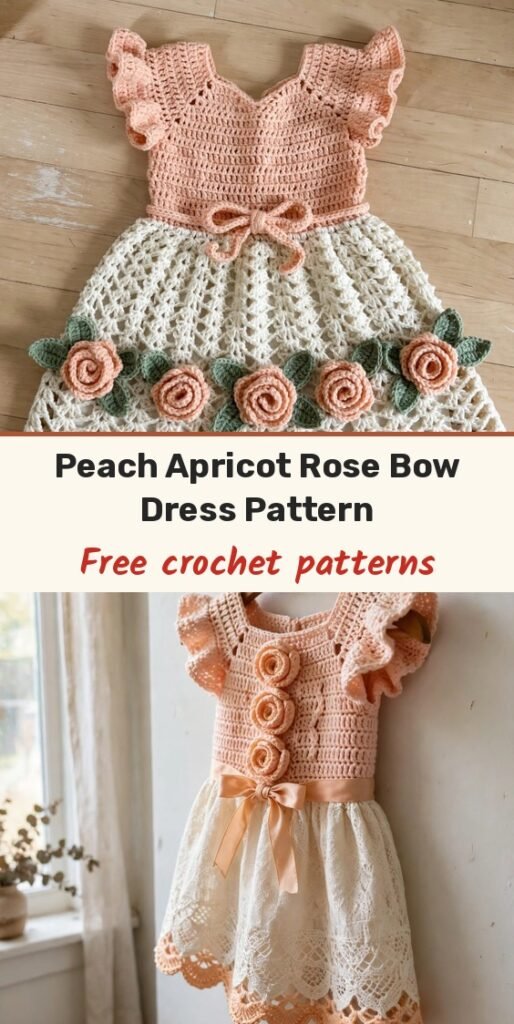
Table of Contents
I know toddler occasion dresses can look intimidating, all those roses and that lacy hem, but here is the truth: if you can double crochet and single crochet, you already have the foundation for this entire dress. The roses are just strips you roll up, the lace is a simple V-stitch repeat, and the sleeves are easy little ruffles.
This sweet dress is designed for toddlers of about 2 to 3 years, with a finished chest of 56 cm (22 inches) and a shoulder-to-hem length of about 46 to 49 cm. Soft peach makes the bodice, ivory flows through the lace skirt, and apricot brings the sleeves, hem, bow and roses to life, with sage green leaves tucked underneath.
We will work a two-panel bodice, join it at the shoulders and sides, then work the skirt downward from the lower edge. A back opening with snap closures makes dressing easy. Let me walk you through every step.
Materials
- Sport weight or fine-weight cotton yarn, approximately 125 m per 50 g ball: Soft peach 300 m for the bodice, Ivory 400 m for the skirt, Apricot 250 m for sleeves, hem border, bow and roses, Sage green 50 m for leaves, plus about 25 m each of contrast colours for flower centres
- 3.5mm crochet hook for the main garment
- 3mm crochet hook for appliqués and cords
- 2.5mm crochet hook (optional) for tiny flowers
- Tapestry needle
- Stitch markers
- Tape measure
- Scissors
- Rust-resistant blocking pins
- 3 small sew-in snaps with backing fabric
Abbreviations
- ch: chain
- sl st: slip stitch
- sc: single crochet
- hdc: half double crochet
- dc: double crochet
- tr: treble crochet
- st/sts: stitch / stitches
- sp: space
- inc: increase, 2 stitches worked in one stitch
- V-st: V-stitch (see Special Stitches)
- sc2tog: single crochet two together
Special Stitches
- V-stitch (V-st): Work (dc, ch 1, dc) all in one location. The skirt lace is built from V-stitches anchored between single dc columns.
Gauge & Size
- Finished size: toddler 2 to 3 years; chest 56 cm (22 inches) for a body chest of 50 to 52 cm with 4 to 6 cm of ease; total length about 46 to 49 cm, bodice depth about 22 cm
- Gauge: 20 dc and 12 rows = 10 x 10 cm, blocked
- Construction: two bodice panels seamed at shoulders and sides, skirt worked in rounds from the lower bodice edge, flutter sleeves, lace hem, rolled rose appliqués and a waist bow
- Skill level: Intermediate
Front Bodice
With soft peach and your 3.5mm hook, ch 58. The turning ch 1 or ch 2 does not count as a stitch anywhere in this pattern.
Row 1: Dc in 3rd ch from hook and in each remaining ch. Turn. (56 dc)
Rows 2 through 14: Ch 2, dc in every st. Turn after each row. (56 dc)
Do not work a stitch into the turning chain.
Row 15 (armhole shaping): Sl st in the first 4 stitches. Ch 2, dc in each of the next 48 stitches. Leave the final 4 stitches unworked. Turn. (48 dc)
The 4 unworked stitches on each side form a 2 cm underarm ledge.
Rows 16 through 20: Ch 2, dc in all 48 stitches. Turn. (48 dc each row)
At gauge, your full panel should now measure about 16.7 cm tall. Place removable markers around the outermost 10 stitches at each edge. The central 28 stitches will form the neckline opening.
First Shoulder, Rows 21 through 26: Ch 2, dc in the first 10 stitches. Leave the remaining 38 stitches unworked. Turn. (10 dc)
Work 5 more rows of 10 dc, turning each row. Fasten off with a long sewing tail.
Second Shoulder, Rows 21 through 26: With the same face of the panel toward you, attach yarn at the opposite outer edge of Row 20. Work toward the centre: ch 2 and dc across only the outermost 10 stitches. Turn.
Work 5 more rows of 10 dc. Fasten off.
Both shoulder straps should have 6 rows above Row 20. Checkpoint: panel width below armholes 28 cm, width above underarm ledges 24 cm, shoulder width 5 cm each, neckline gap 14 cm, overall height approximately 21.7 cm.
Back Bodice
Rows 1 through 14: Using soft peach, make a second panel exactly as you did for the front: 56 dc each row for 14 rows. Mark the centre between stitches 28 and 29.
Left Half, Row 15: Sl st in first 4 sts. Ch 2, dc in next 24 sts, stopping at the centre marker. Leave the other half unworked. Turn. (24 dc)
Left Half, Rows 16 through 23: Ch 2, dc in each st. Turn. (24 dc) Fasten off.
Right Half, Row 15: Return to the unworked half of Row 14. Attach yarn at the centre marker and work toward the outer edge: ch 2, dc in the next 24 sts, leaving the final 4 sts unworked. Turn. (24 dc)
Right Half, Rows 16 through 23: Work as for the left half. Fasten off.
The centre edges remain separate to create the back opening.
Back Shoulders, Rows 24 through 26: On each half, attach yarn at the outer armhole edge of Row 23 and dc across the outermost 10 sts. Leave the inner 14 sts unworked. Turn.
Work 2 more rows of 10 dc. Fasten off.
The two 14-st inner gaps create a 28-st back neckline.
Joining the Bodice
Block both panels to the target measurements. With right sides together, join each pair of 10-st shoulder tops using mattress stitch: align matching edges and pick up one small strand from each edge alternately with your tapestry needle, tightening gradually so the join lies flat.
Join the side edges from the foundation edge through Row 14 only, matching rows carefully. Keep all upper edges open for armholes. Turn right side out.
The lower edge has 56 foundation stitches on each panel, 112 total.
Skirt
Round 1: With ivory, join at a side seam of the 112-st lower bodice edge. Ch 2, work 2 dc in every foundation stitch. Join. (224 dc)
Round 2: Ch 2. Repeat [dc in next 13 sts, 2 dc in next st] 16 times. Join. (240 dc)
Round 3 (establish lace pattern): Ch 2. Repeat [dc in next st, skip 1 st, V-st in next st, skip 1 st] 60 times. Join to first dc.
Each repeat uses 4 old stitches. You now have 60 single dc columns, 60 V-sts, and 60 ch-1 spaces. (180 dc total)
Rounds 4 through 24: Ch 2. Repeat [dc in next single dc column, skip the first dc of the V-st, V-st in its ch-1 space, skip its second dc] 60 times. Join to first dc.
Maintain 60 repeat units every round. Mark the first column to avoid mistaking a V-st leg for it. Turn after each round.
Hem Foundation: Ch 1. Work 1 sc in every dc and 1 sc in every ch-1 space around. Join. (180 + 60 = 240 sc)
The lace body should measure around 20 cm when blocked. Measure before adding the border.
Flutter Sleeves
Use apricot and your 3.5mm hook. On one armhole, identify the shoulder seam. Measure 6 cm down the front edge and 6 cm down the back edge. Mark both points.
Sleeve Foundation: Join at the front marker. Work 30 sc evenly across the 12 cm upper arc to the back marker, crossing the shoulder seam. Do not work around the lower underarm.
Row 2: Turn. Ch 2, 2 dc in each sc. Turn. (60 dc)
Row 3: Ch 2. Repeat [dc in next st, 2 dc in next st] 30 times. Turn. (90 dc)
Row 4: Ch 1, sc in every st. Fasten off. (90 sc)
Repeat on the other armhole, matching the marked arc and stitch counts.
Lace Hem Border
Hem Round 1: With apricot, join in any of the 240 hem-foundation sc. Ch 1 and sc in that same stitch. Repeat 24 times: skip next 4 foundation sts, 11 tr in next st, skip next 4 foundation sts, sc in next st.
The last sc location is where you started. Instead of making a second sc there, join to the first sc. You now have 24 fans of 11 tr and 24 sc anchors.
Hem Round 2: Ch 1, sc in same anchor. For each fan: ch 1, work dc in each of its 11 tr with ch 1 between adjacent dc, ch 1, sc in the next anchor.
On the last fan, join to the first sc instead of making a duplicate anchor. Each fan now has 11 dc and 12 ch-1 spaces.
Hem Round 3: Ch 1. Sc in each sc anchor, each dc, and each ch-1 space around. Join and fasten off. (576 sc)
Keep your tension relaxed. When blocking, wet-block individual fans into smooth rounded scallops without pulling the skirt waist wider.
Rose Motifs
Small Rose (petal strip): With apricot and your 3mm hook, ch 42.
Row 1: Sc in 2nd ch from hook and each ch across. Turn. (41 sc)
Row 2: Ch 1. Sc in first st. Repeat [skip 1 st, 5 dc in next st, skip 1 st, sc in next st] 10 times.
You have 10 petals and 11 anchoring sc. Fasten off, leaving 35 cm for sewing.
Shaping the rose: starting at one short end, roll the strip with the scallops pointing upward. Keep the first two petals tight for the centre, then overlap the others more loosely. Stitch through every layer across the underside. Aim for a 4 to 5 cm flower, and do not leave a loose spiral.
Large Waist Rose: Make a second strip with ch 58. Work 57 sc in Row 1 and 14 petals in Row 2 using the same repeat. Roll and sew. Aim for 6 to 7 cm.
For a two-colour bouquet, make half the small roses in soft peach and half in apricot.
Leaves & Filler Flowers
Pointed Leaf: With sage green and your 3mm hook, ch 9. Working along one side: sl st in 2nd ch from hook, sc in next, hdc in next, dc in next 3, hdc in next, and (sc, ch 2, sc) in the last ch. Continue along the opposite side of the same chain: hdc in next, dc in next 3, hdc in next, sc in next, sl st in last. Fasten off with a sewing tail. Embroider a straight vein down the middle if desired.
Tiny Filler Flower: With a contrast colour and your 3mm hook, make a magic ring. Ch 1, then repeat 5 times into the ring: ch 2, 2 dc, ch 2, sl st. Tighten, fasten off, and sew the centre securely. Embroider a contrasting centre using three short straight stitches.
Make in total: 7 main rose motifs for the lower-front garland, 14 leaves, and 8 tiny filler flowers. Keep the dress back plain so the design stays comfortable when seated.
Appliqué placement: lay the blocked dress flat. Mark the front centre and both side seams. Arrange motifs 3 to 5 cm above the start of the lace hem, distributing them evenly between the side seams. Overlap only the leaf bases, not their tips. Baste first, then sew around all edges and through every layered centre with small matching stitches.
Waist Bow
Large Bow Rectangle: With apricot and your 3.5mm hook, ch 74.
Row 1: Sc in 2nd ch from hook and across. (73 sc)
Rows 2 through 18: Ch 1, sc in each st. Turn. (73 sc)
Fasten off. Block the rectangle to about 36 x 7 cm. The folded bow will be about 18 cm wide. Fold the two short ends to the centre back with a 1 cm overlap and stitch together.
Centre Wrap: Ch 9. Sc in 2nd ch from hook and across. (8 sc) Work 8 rows total, turning each time.
Pinch the middle of the bow rectangle into three folds. Wrap the small strip around it and sew its ends together on the reverse. Secure through the folded layers.
Two Tails: For each tail, ch 11. Sc in 2nd ch from hook and across. (10 sc) Work 34 rows total, or until 15 cm long. On the last row, skip the first st and sc in the remaining 9 for a softly angled end. Fasten off.
Attaching the bow: sew the tail tops behind the bow. Position the bow at the front waist and angle the tails downward and outward. Sew the bow centre and both outer loops securely, and stitch each tail along its length and at its lower end, keeping it flat to the skirt without stretching the lace.
Finishing & Assembly
Neckline edging: using soft peach, join at the back neck. Work 1 sc per horizontal stitch and approximately 2 sc per dc row-end around the neck, excluding the vertical centre-back slit. At inner corners, work sc2tog across the corner if needed to lie flat. Join. Work one more round of sc. Join and fasten off.
Back bands: along each vertical back-slit edge, work 2 sc into each dc row-end for Rows 15 through 23. Turn. (18 sc) Work 2 more rows of 18 sc. Fasten off. Lightly block the two bands so they overlap by about 1 cm without pulling the back panel.
Closures: sew three snaps through small soft backing patches at approximately 1 cm below the top of the slit, at the midpoint, and 1 cm above its bottom. Align paired halves before stitching, and confirm the opening allows easy dressing without pulling the neckline.
Weave all ends through several stitches, reverse direction, and secure before trimming.
Blocking: wash according to your yarn label. Gently press out water in a towel; do not wring. Pin the bodice to 56 cm chest circumference, ease the skirt outward without stretching the waist, and shape the lace scallops, sleeve ruffles, and appliqués. Dry completely on a flat surface.
Tips
Take your time with the roses. They look impressive, but they are honestly just strips that you roll up and stitch. If your first one looks a little wonky, your second will be better.
Mark your stitches in the lace section. A simple marker in that first single dc column will save you so much frustration.
Block before attaching appliqués. Your motifs will sit much better on a properly blocked dress.
This dress is occasion clothing, not sleepwear. The lace panels need a sewn cotton slip or suitable underdress where the fabric is open, and snaps and appliqué attachments should be checked before each wear.
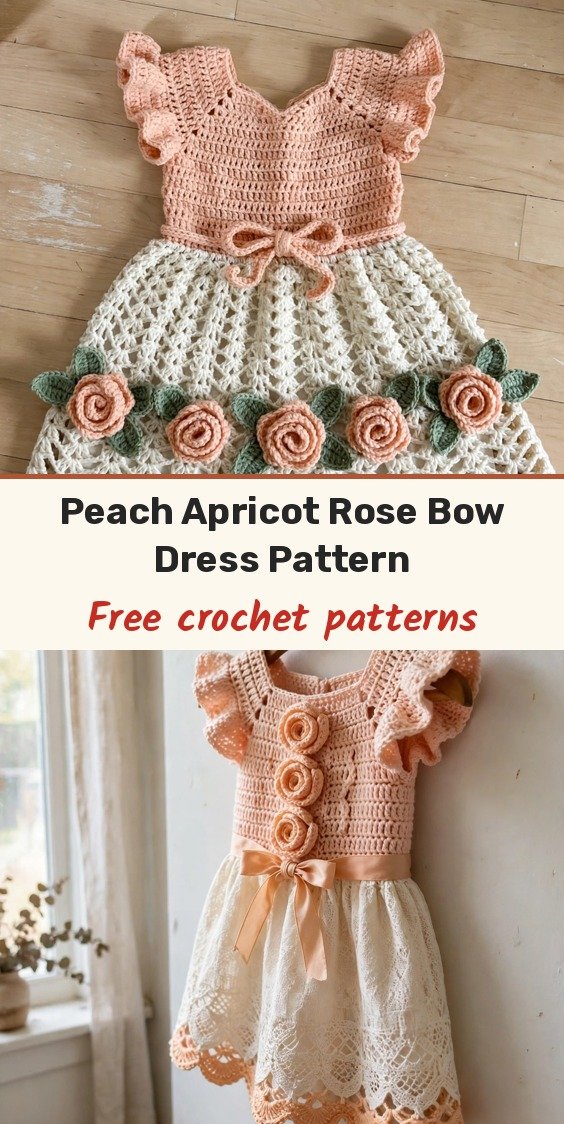
Peach Apricot Rose Bow Dress Crochet Pattern
Materials
Steps
- Work the front bodice with armhole and shoulder shaping, 56 dc tapering to 10 dc shoulders
- Work the back bodice in two halves with shoulders
- Seam shoulders and sides, leaving a 112-st lower edge
- Work the skirt: increase to 240 dc, then 21 rounds of V-stitch lace
- Add flutter sleeves and the 3-round lace hem border of 24 fans
- Make and roll 7 rose motifs, 14 leaves and 8 tiny filler flowers; sew on the garland
- Make the waist bow with centre wrap and two tails and sew it on
- Add neckline edging, back bands and 3 snaps, then block
- Count your shells: the lace skirt holds exactly 60 repeat units every round
- Block the dress before sewing on appliques so motifs sit flat
- Roll roses with the first two petals tight for a neat centre
- Check snaps and applique stitching before each wear