Blue Porcelain Lace Runner Crochet Pattern
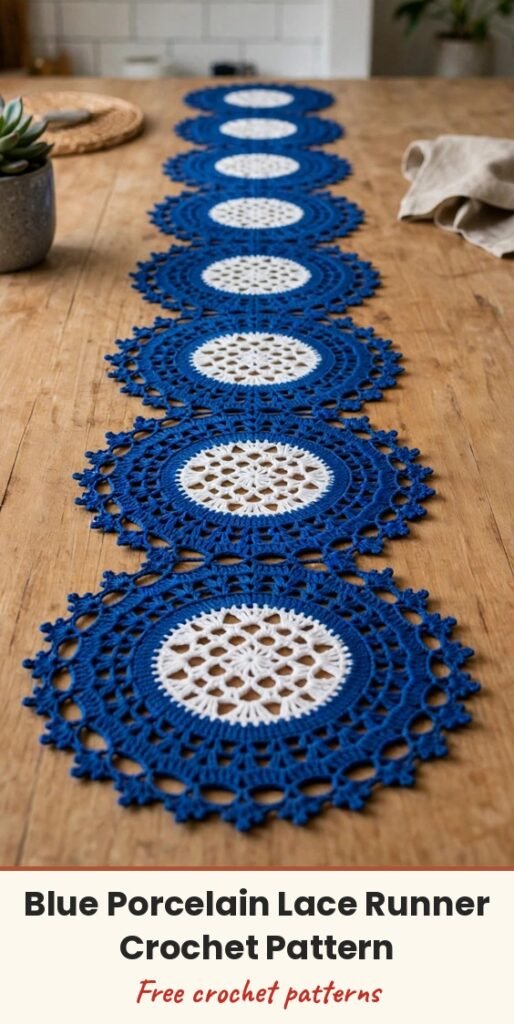
Table of Contents
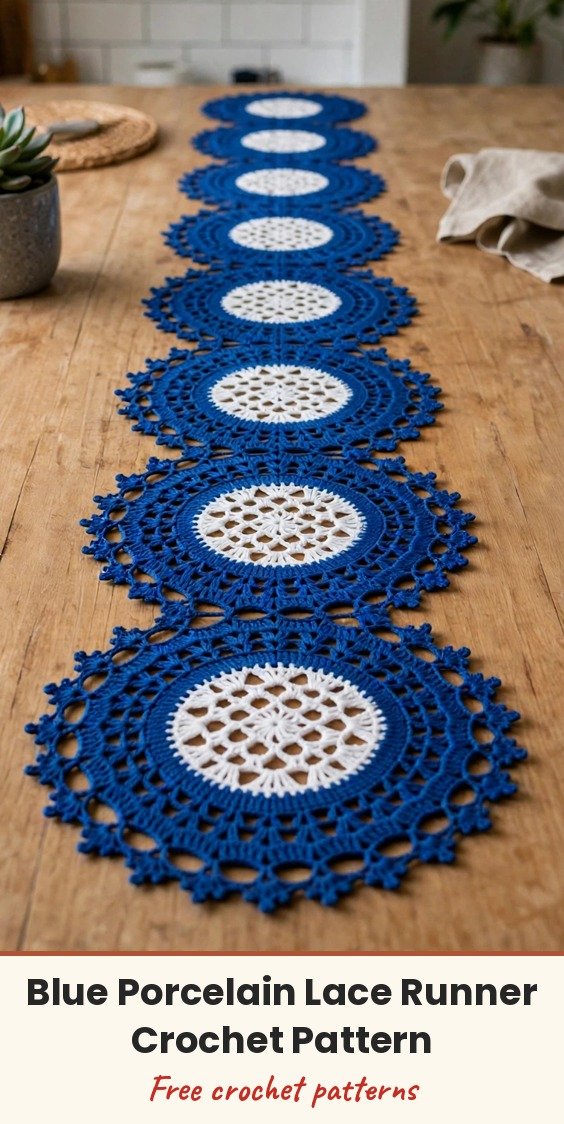
I love the blue-and-white porcelain look, and this runner captures it in the cleverest way. Instead of wrestling with colour changes in one huge piece, we make separate circular medallions in cobalt and white, work little filet diamonds in white, and join everything into one long, elegant runner.
Each medallion grows through rings of chain arches and finishes with a picot round, and each diamond is a neat nine-row filet shape that nests into the centre of a circle. Sixteen of each sounds like a lot, but they are portable, quick, and deeply satisfying to stack up.
Blocking matters enormously here, so please make one medallion and one diamond first, wash and block them, and check the measurements before you commit to all sixteen. Your future self will thank you.
Materials
- 150 g Size 3 mercerized crochet cotton in cobalt blue (Color A), approximately 250 m per 50 g
- 150 g Size 3 mercerized crochet cotton in white (Color B), approximately 250 m per 50 g
- 2.5mm crochet hook, or size needed to achieve gauge
- Fine tapestry needle
- Rustproof pins, blocking mat and towels for wet blocking
- Tape measure
Abbreviations
- ch: chain
- sl st: slip stitch
- sc: single crochet
- hdc: half double crochet
- dc: double crochet
- tr: treble crochet
- st/sts: stitch / stitches
- sp: space
- RS / WS: right side / wrong side
- rep: repeat
Special Stitches
- Filet cell: ch 2 followed by a tr in the next tr. An open cell has two chains between its treble posts.
- Picot: ch 3, then sl st in the first of those three chains. This creates a small decorative bump along the edge.
- Joining bridge: ch 2, sl st in the corresponding edge loop of the next medallion, ch 2, sl st back into the starting loop.
Gauge & Size
- Finished size: approximately 128 by 32 cm, made of 16 medallions in an 8 by 2 grid with a filet diamond centred on each
- Gauge: a blocked circular medallion measures 16 cm in diameter; a filet diamond measures approximately 9 cm wide by 14 cm long after blocking
- Construction: 16 medallions and 16 diamonds made separately, blocked, joined with bridges, tacked together, and wet blocked as one piece
- Skill level: Intermediate
Medallion Pattern
Make 16 identical medallions. Join each round to its first counted stitch, keeping the right side facing. On diamond rows below, the turning ch 4 counts as the first tr, and at an increase edge ch 6 counts as one tr plus ch 2. All medallions have 16 radial repeats; number the outer loops 1 to 16 clockwise, with loop 1 at the top, loop 5 pointing right, loop 9 at the bottom and loop 13 pointing left. We will need that numbering for assembly.
Round 1 (Color B, white): Create an adjustable ring. Ch 3 (counts as your first dc), then work 15 dc into the ring. Tighten the ring and join to the top of the ch 3. [16 dc]
Round 2 (Color B): Ch 4 (counts as dc plus ch 1). (Dc in next dc, ch 1) 15 more times. Join to the third chain of the starting chain. [16 dc, 16 ch-1 spaces]
Round 3 (Color A, cobalt blue): Join in any ch-1 space, ch 1. (Sc in next ch-1 space, ch 3) 16 times in total. Join to first sc. [16 sc, 16 ch-3 arches]
Round 4 (Color A): Sl st into the first arch, ch 1. (Sc in next arch, ch 5) 16 times. Join. [16 sc, 16 ch-5 arches]
Round 5 (Color A): Sl st into the first arch, ch 1. (Sc in next arch, ch 7) 16 times. Join. [16 sc, 16 ch-7 arches]
Round 6 (Color A): Sl st into the first arch, ch 1. (Sc in next arch, ch 9) 16 times. Join. [16 sc, 16 ch-9 arches]
Round 7 (Color A): Sl st into the first arch, ch 1. (Sc in next arch, ch 11) 16 times. Join. [16 sc, 16 ch-11 arches]
Round 8 (Color B, white): Join in any outer arch. In each arch around, work: 5 sc, picot, 6 sc. Join and fasten off. [176 sc, 16 picots]
Block each medallion by pinning each outer picot evenly around a 16 cm circle on your blocking mat.
Filet Diamond Pattern
Make 16 identical diamonds in Color B (white).
Row 1: Ch 7. Work tr in the seventh chain from hook. The initial six chains count as the first tr plus ch 2. [2 tr posts, 1 open cell]
Row 2: Ch 6, turn. Tr in first tr (this creates your first new cell). Ch 2, tr in last tr. Ch 2, tr in same last tr. [4 tr posts, 3 cells]
Row 3: Ch 6, turn. Tr in first tr. (Ch 2, tr in next tr) 3 times. Ch 2, tr in same last tr. [6 tr posts, 5 cells]
Row 4: Ch 6, turn. Tr in first tr. (Ch 2, tr in next tr) 5 times. Ch 2, tr in same last tr. [8 tr posts, 7 cells]
Row 5: Ch 6, turn. Tr in first tr. (Ch 2, tr in next tr) 7 times. Ch 2, tr in same last tr. [10 tr posts, 9 cells]
Row 6 (begin decreases): Turn. Sl st across the first ch-2 space into the second tr. Ch 4 (counts as first tr). (Ch 2, tr in next tr) 7 times. Leave the last cell unworked. [8 tr posts, 7 cells]
Row 7: Turn. Sl st across the first ch-2 space into the second tr. Ch 4. (Ch 2, tr in next tr) 5 times. Leave the last cell unworked. [6 tr posts, 5 cells]
Row 8: Turn. Sl st across the first ch-2 space into the second tr. Ch 4. (Ch 2, tr in next tr) 3 times. Leave the last cell unworked. [4 tr posts, 3 cells]
Row 9: Turn. Sl st across the first ch-2 space into the second tr. Ch 4, ch 2, tr in next tr. Leave the last cell unworked. Fasten off. [2 tr posts, 1 cell]
Block each diamond elongated, distributing the increases evenly so the widest point (the 9-cell centre at Row 5) measures about 9 cm wide.
Finishing & Assembly
Arranging: lay all circles right side up in 8 rows by 2 columns. Orient all loop 1 points toward one end of the runner. Place the diamonds lengthwise over the circles, keeping all four cardinal join points accessible. You will need Color B (white), your 2.5mm hook, and a tapestry needle.
Join Pass 1 (lengthwise joins): along each lane, create a joining bridge from loop 9 of one circle to loop 1 of the next circle. Also bridge adjacent loops: loop 8 to loop 2, and loop 10 to loop 16. These stabilising joins prevent twisting. [14 joins x 3 bridges each]
Join Pass 2 (width joins): join loop 5 of each left circle to loop 13 of its right neighbour. Add stabilising joins from loop 4 to loop 14, and loop 6 to loop 12. [8 joins x 3 bridges each]
Checkpoint: your grid should have 16 medallions with 22 motif-to-motif joins, and no circles should be twisted.
Attaching the diamonds, Sewing Pass 1: centre each diamond vertically on its circle. Tack the upper and lower tips plus both widest corners with two small stitches per point. [64 tack points total]
Attaching the diamonds, Sewing Pass 2: tack the diamond centre to the ring centre, being careful not to collapse the open cells. [16 central tacks]
Checkpoint: every diamond should lie flat, the arches should remain open, and the underside should have no long loose thread floats.
Edging Pass 1: keep the Round 8 picots on all exposed loops around the perimeter. At joined loops, fold the picots inward and secure them under the join with one tack stitch.
Detail Pass 2: verify every exposed picot has exactly 3 chains and a proper closing slip stitch. The outside contour should appear balanced, all attachments should withstand a gentle pull, and no joining tails should be visible on the right side.
Weave all ends through dense single crochet sections in two directions for at least 2 cm, and trim only after the final blocking. For the final wet blocking, soak the completed runner briefly in cool water, roll it in a towel to remove excess moisture, then pin it to approximately 128 by 32 cm on your blocking mat. Verify all medallions measure 16 cm in diameter and all diamonds match their intended dimensions. Allow the runner to dry completely before removing the pins.
Tips
Mercerized cotton has a lovely sheen but can feel slippery at first. Your tension will improve as you work through the first few medallions.
If your medallion cups inward, loosen your chain arches. If it ruffles, verify your repeat count is exactly 16, and change hook size as needed to reach 16 cm without forcing the lace.
Hand wash the finished runner in cool water with a colour-safe mild detergent. Do not wring. Roll in a towel to remove water and reblock flat to dry. This runner is not heat-resistant, so always use a protective mat under hot dishes.
You can adjust the length by adding or removing medallion rows: each row of two medallions adds approximately 16 cm to the total length.
Blue Porcelain Lace Runner Crochet Pattern
Materials
Steps
- Make 16 circular medallions over 8 rounds each, ending with the picot round (176 sc, 16 picots)
- Block each medallion to a 16 cm diameter circle
- Make 16 filet diamonds over 9 rows each, widening to 9 cells then decreasing to 1 cell
- Block each diamond to about 9 by 14 cm
- Lay the medallions out in an 8 by 2 grid with loop 1 points aligned
- Join the medallions with lengthwise and width joining bridges (22 joins)
- Centre a diamond on each medallion and tack it at 4 points plus the centre
- Fold picots inward at joined loops and wet block the runner to 128 by 32 cm
- Make and block one medallion and one diamond first to check gauge
- Keep the medallion repeat count at exactly 16 or the lace will cup or ruffle
- Number the outer loops 1 to 16 before assembly so the bridges land correctly